
A year ago I sketched an idea for an AI that lives in group chats and mostly keeps its mouth shut. Since then, OpenAI shipped group chats and quietly killed them, Anthropic built the closest thing I’ve seen, and researchers turned “when to speak” into a measurable, trainable skill.
The idea is more relevant than ever. Nobody has built it yet. Here’s the update.
Why it matters: For the second year running, the #1 way people use generative AI isn’t coding or writing. It’s therapy and companionship. We’re swapping the messy, rewarding work of human relationships for a frictionless machine that always answers and rarely disagrees.
Social media promised to connect us and delivered loneliness. We’re about to make the same mistake again. This time with AI companions.
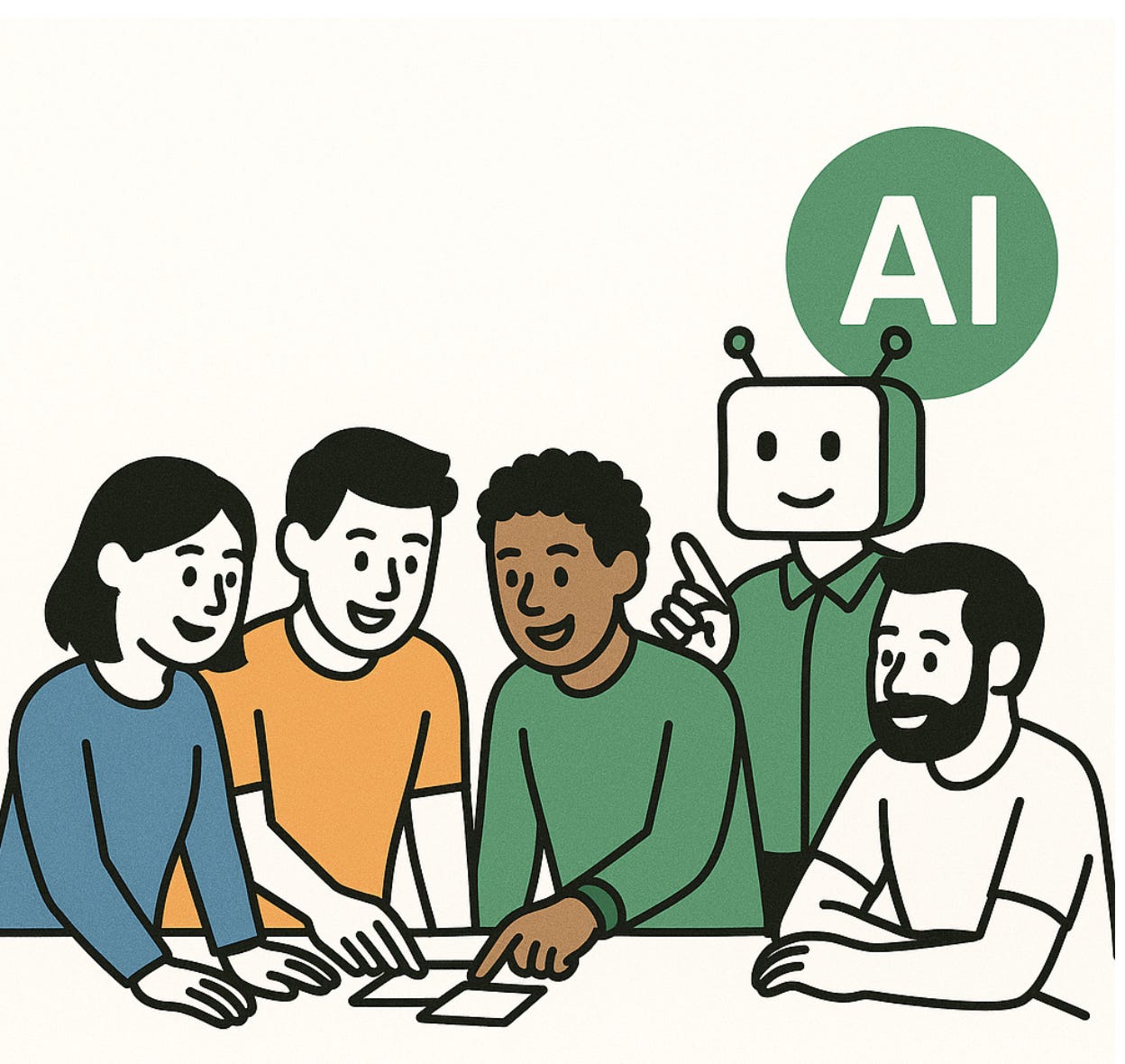
The idea: An open-source orchestrator that sits in a group chat and helps humans connect with each other. The hard part isn’t generating a response. It’s knowing when not to. Default behavior is restraint. The system has to justify why it should speak.
What happened this year
OpenAI tried it and quit. Days after I wrote the first draft, OpenAI launched group chats in ChatGPT: up to 20 people, and the model “decides when to respond and when to stay quiet.” No personal memory, and the AI was just another member. On July 9, 2026, they retired it to “keep the product simpler.” Group chat is hard.
Anthropic went the other way. Claude Tag lives in Slack channels and responds when tagged — or on its own, when it judges it can help. In August, Anthropic said it had made Claude about 30% better at deciding when not to respond by replacing a per-message yes/no classifier with channel-wide context, memory, and standing instructions. For any message it can reply inline, start a thread, route it to work already in progress, or say nothing. If it keeps finding nothing to add, it goes dormant until someone tags it.
That’s the waiter at a fine restaurant who perfectly reads the room. It’s also proprietary, enterprise-only, and built to get work done, not to help people connect.
Everyone else built a search box. Meta AI in WhatsApp groups and Gemini in Google Messages only answer when you summon them.
The research caught up
“When to speak” now has datasets, benchmarks, and a growing body of research:
When2Speak (May 2026): 215,000 turns labeled SPEAK or SILENT across 16,000 multi-party conversations, open source. Fine-tuned models beat zero-shot by 60%, then swung too far the other way, missing half the moments they should have spoken, until reinforcement learning with asymmetric rewards fixed it. Restraint is a dial, not a switch.
Time to Talk (EMNLP 2025): an agent that plays Mafia with humans using two separate modules, a scheduler that decides whether to send and a generator that decides what. Its timing was indistinguishable from humans’. Timing and content are different problems.
To Facilitate or Not to Facilitate (2026): ten expert human facilitators and six open-source LLMs rated the same discussions. Humans mostly chose not to intervene. The LLMs were “excessively eager to facilitate.” A small fine-tuned classifier beat them all. The over-eagerness I worried about is real, and now measured.
ProMediate (Microsoft, April 2026): a benchmark for proactive AI mediators. Key finding: the interaction strategy and “proactivity architecture” matter as much as model size.
HUMA (November 2025): a group-chat facilitator built as a Router → Action → Reflection loop with realistic response delays. 97 participants couldn’t tell it from a human community manager.
Another Bitter Lesson of AI
Three large experiments put AI facilitators in front of real human groups this year:
1,475 people in 281 groups (MIT and Microsoft Research): a GPT-4o facilitator raised the floor. The quietest members shared more, at limited cost to how people felt about the group. It didn’t improve the decisions.
879 people allocating real money: people preferred the AI-facilitated discussions and trusted the process more. But participation didn’t get more balanced, and the facilitator quietly shifted where the money went by up to 5.5 points. The authors call it “the illusion of inclusion.”
112 students in peer-support groups for exam anxiety: human facilitators beat the AI on every measure. The AI held its own. Emotional connection predicted everything else.
My read: a facilitator that makes people feel included while steering them is worse than none. The objective has to penalize steering, and the evals have to measure outcomes, dynamics, and perceptions separately, because they diverge.
Does it exist yet?
No. But the parts do.
When2Speak’s dataset and training pipeline are public, and the 1,475-person study released GRAIL, an open platform for running these experiments.
Microsoft’s Agent Framework “group chat” orchestration and AutoGen’s GroupChat are a name collision. They orchestrate AIs talking to AIs but not among people.
Nobody has assembled the restraint layer: an open-source, model-agnostic “should I speak” brain for human group chats. Which likely could rely on something like Jev, an emergent “system-one” AI that could simply look at each message and quickly determine whether to ‘no-op” or respond and then pass off to another model to reply.
The updated spec
Separate the scheduler from the generator. Every message gets scored speak-or-wait by a small, fine-tuned classifier — something like Jev — trained on When2Speak and the facilitation corpora. Cheap enough to run on every message, and demonstrably better at restraint than prompting a frontier model.
The restraint dial. Temperature, but for intervention. Turn it down and the AI barely speaks; turn it up and it facilitates. New this year: asymmetric rewards, so the low setting doesn’t collapse into total silence.
The intervention hierarchy. Observe → nudge → redirect → facilitate → intervene. Ask questions of the group before providing answers.
Three layers of state: individual, group, conversation. Claude Tag’s gain came from channel-wide context, not a smarter per-message judge.
A configurable objective with one hard constraint. Optimize for balanced participation, learning, creative output, or vibes, but penalize any shift in the group’s outcome that the group didn’t drive itself. No steering.
Dormancy. Nothing worth saying for a while? Go quiet until invited back.
Build it as an OpenClaw plugin, not a new platform. The pipes are done.
Open questions, updated
Over-eagerness is now measurable. How does the system stay calibrated as a group’s tolerance for it changes over weeks or months?
Does the illusion of inclusion disappear when the facilitator asks instead of tells?
How do you detect steering from inside the system, before a researcher does?
What does equitable facilitation look like across cultures? Still nobody has studied it.
Productive struggle vs. frustrating silence. Still open.
The bottom line: OpenAI proved group AI is hard. Anthropic proved restraint can be learned. Researchers proved out-of-the-box models can’t be trusted to shut up, and that an eager facilitator can make people feel included while quietly herding them.
Names I still like for a potential project: Harkness, Murmur, Chorus, or Cue.
Someone, please steal this idea. And if you build it, please send me the repo.