
Colleges get paid whether you graduate or not. That’s a bug in the system.
What if every school that took federal student aid had to buy insurance on its students’ debt, and the policy only paid out if the school actually did its job?
The problem we keep paying for
Right now, when a student borrows, enrolls, and leaves without a degree, the school keeps the tuition, the student keeps the debt, and taxpayers eat the default.
Everyone pays except the one party that could have changed the outcome.
37.6 million working-age Americans have some college and no credential. And borrowers who don’t finish are more than twice as likely to default as those who do (59% vs. 23% in Pew’s survey).
Debt without a degree is the worst deal in higher ed, and the school bears none of the downside.
The idea: insure the diploma
Every school that takes federal aid buys a policy on its students’ loans. If a student borrows and doesn’t graduate, the policy pays down the debt.
Suddenly the school has skin in the game. Not through a fine or a federal mandate, but through a premium it pays every year.
Graduate more students, and pay less. Lose them, and you’ll pay more.
Students chip in a sliver too, so everyone has a stake in finishing.
The analogies
Car insurance. Your rates depend on your driving record. After a crash, your insurer fixes your car first and sorts out fault later. If the other driver caused it, your insurer collects from them. If you caused it, you pay more. Here, the loan is the car, the pool is the insurer, and the school is the other driver.
GAP insurance. If your car gets totaled while you still owe more than it’s worth, GAP covers the difference. Its cost is often rolled right into the loan. You’re not stuck making payments on a car you can’t drive. Debt without a degree is the same trap: payments on a diploma that never showed up.
The FDIC. Banks pay for deposit insurance at rates priced by risk, set partly by the CAMELS ratings their examiners hand out. Safer bank, cheaper premium. This is basically the FDIC for diplomas.
Bond ratings. Moody’s already rates colleges. It just rates whether they’ll repay their bondholders, not whether they’ll graduate their students.
The catch: you’re only covered if you did the work
The policy is compliance-gated. Follow the best practices and the pool covers the loss. Fall short, and the student still gets covered, but the school pays the pool back.
That kills the moral hazard. A school can’t run a sloppy operation and dump the cost on the insurer. Medicine has a standard of care. Higher ed doesn’t. This would create one.
What counts as best practice? Mostly things we already know work:
Advising ratios that let someone actually know each student
Early-alert systems that catch students before they slip away
Proactive advising and just-in-time interventions
Financial aid and emergency aid that show up on time
Honest, public outcomes data
Don’t build a new regulator. Use the one we have.
Roll the audit into accreditation. Accreditors already do deep institutional reviews on a regular cycle. They already have standards. They just don’t have teeth.
Today accreditation is basically binary. You’re in or you’re out, and pulling it is a nuclear option nobody wants to use. Tie insurability to the review, and every finding suddenly has a price.
It also fixes the coziness problem. Accreditors get accused of being too close to the schools they review. Add an insurer with real money on the line, and someone in the room finally has a reason not to go soft.
A credit score for colleges
You have a credit score for paying your credit card bill. Schools should have one for graduating their students.
The rating moves, and it sets the premium. A school sliding from AA to BBB feels it in the budget years before it’s anywhere near losing accreditation. That’s a gradient instead of a cliff. An early warning instead of a funeral.
And families get to see it before they borrow a dime.
One rule for the score: measure value added, not raw graduation rates. Judge each school by its outcomes relative to the students it actually enrolls. Otherwise the cheapest move is to stop admitting first-gen and low-income students, which is the exact opposite of the point.
How the money flows
Everyone pays in. Whoever dropped the ball pays out.
It works like a fender bender: the student gets covered first, then fault gets sorted out.
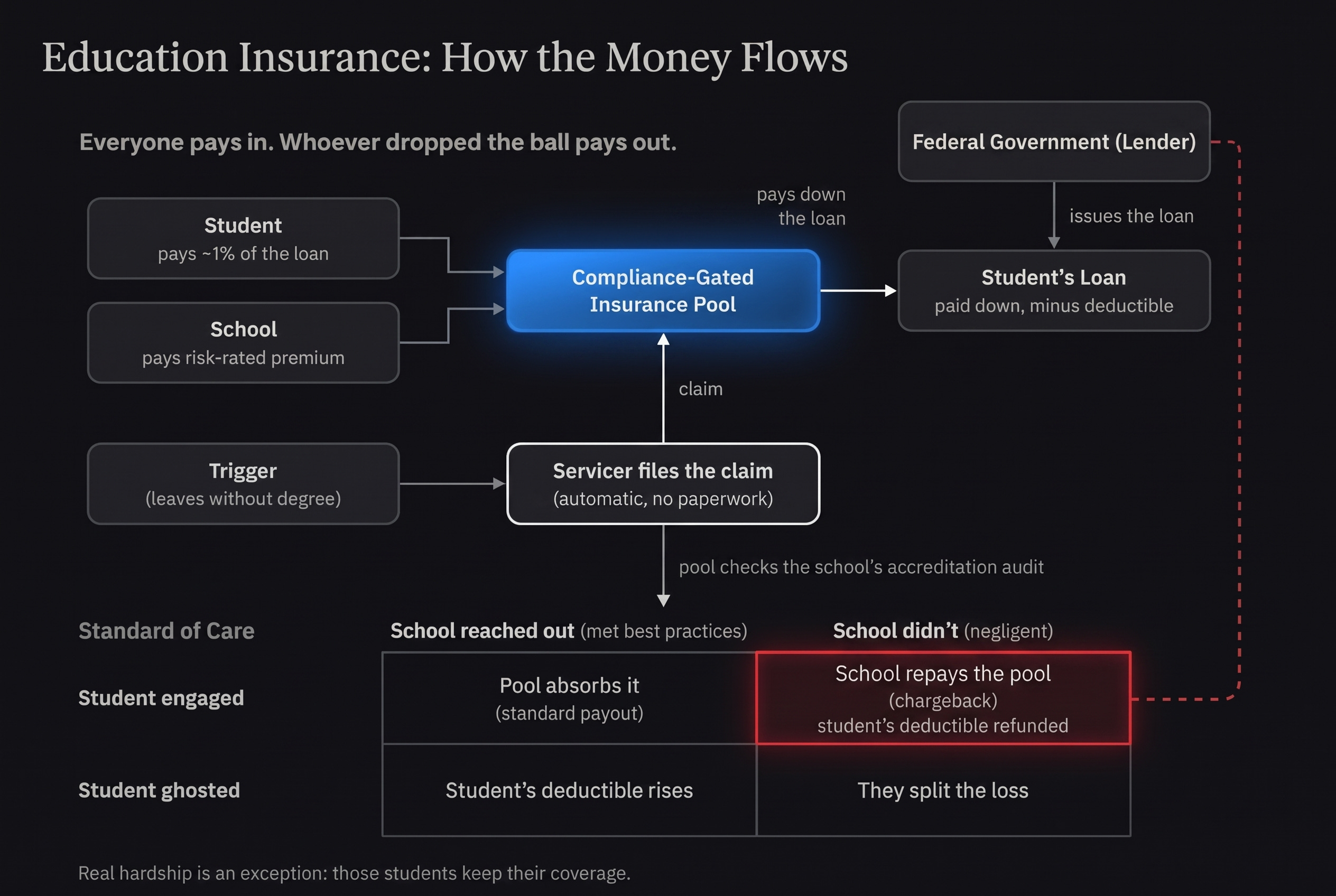
Everyone pays in. The school pays a yearly premium set by its rating. The student pays a sliver of what they borrow, rolled into the loan like GAP coverage.
Nobody has to file a claim. If a student goes a full year with no degree and no enrollment anywhere, the claim triggers on its own. The loan servicer files it, using enrollment data schools already report.
The student gets covered first. The pool pays down the loan, minus a deductible. A student who showed up keeps a small one. A student who ghosted, skipping class and ignoring every outreach, keeps some or all of the debt. Real hardship gets an exception.
Then the pool settles up with the school. It checks the school’s latest accreditation review. If the school met the standard of care, the pool eats the loss. If it didn’t, the school pays the pool back. That’s the chargeback. And a student who showed up gets their deductible back, just like when your insurer collects from the other driver.
💸 The bottom line: Students who try get covered first. Schools pay only when they didn’t do their part.
Why now
Washington already wants schools to have skin in the game. It just reached for a blunt tool.
In 2025, the House version of the big reconciliation bill would have made colleges repay part of the federal loans their former students didn’t. The Senate swapped it out for an earnings test instead.
Penalties are a political fight. Insurance is a market. Premiums, ratings, and audits are things every college CFO already understands.
What I’m NOT prescribing
Who underwrites it: private insurers, a federal pool, or a mutual owned by the schools themselves
Whether it’s required for every school taking federal aid or starts as a voluntary pilot
The premium formula
Those answers should come from people who know actuarial math a lot better than I do.
Open questions
Who counts as “didn’t graduate”? How do we handle stop-outs who come back? Or someone who leaves for a great job?
How to stop schools from gaming the audit, checking every box while still failing students?
How do you keep schools from lowering the bar just to push people across the finish line?
What happens when a school closes mid-policy?
Could the same model cover other forms of education, such as bootcamps, certificates, and income-share agreements?
Possible names
Finish Line
The Diploma Guarantee
Completion Coverage
Commencement Insurance
Please steal this idea. And if you do, tell me how it goes.
~Drew
Sources
Some College, No Credential: A 2025 Snapshot, National Student Clearinghouse Research Center, June 2025
Borrowers With Certain Educational Experiences Appear More Likely to Default, Pew Charitable Trusts, January 2024
Risk-Based Assessments, FDIC
Holding Colleges Accountable: From Graduation to Gainful Employment, American Enterprise Institute, July 2025
Senate Reconciliation Bill is a Better Version of a Bad Idea, American Council on Education, June 2025
What is Guaranteed Asset Protection (GAP) insurance?, Consumer Financial Protection Bureau